


Technical details
Description, documents, and source code.
Product Overview
his board is a 100% hardware-faithful reproduction of the original Pong “E” revision arcade mainboard.
It is designed for:
Restoring or repairing original Pong arcade cabinets
Buildi…
Product Overview
his board is a 100% hardware-faithful reproduction of the original Pong “E” revision arcade mainboard.
It is designed for:
Restoring or repairing original Pong arcade cabinets
Building a standalone Pong arcade system using the optional Arcade Power & I/O Module + Rotary Controllers
This is not an emulator, not FPGA, and not microcontroller-based logic.
It is a full TTL hardware state-machine implementation, just like the original 1972 design.
What’s Included
1 × Pong “E” Revision Mainboard (fully assembled and tested)
Optional:
Arcade Power & I/O Module
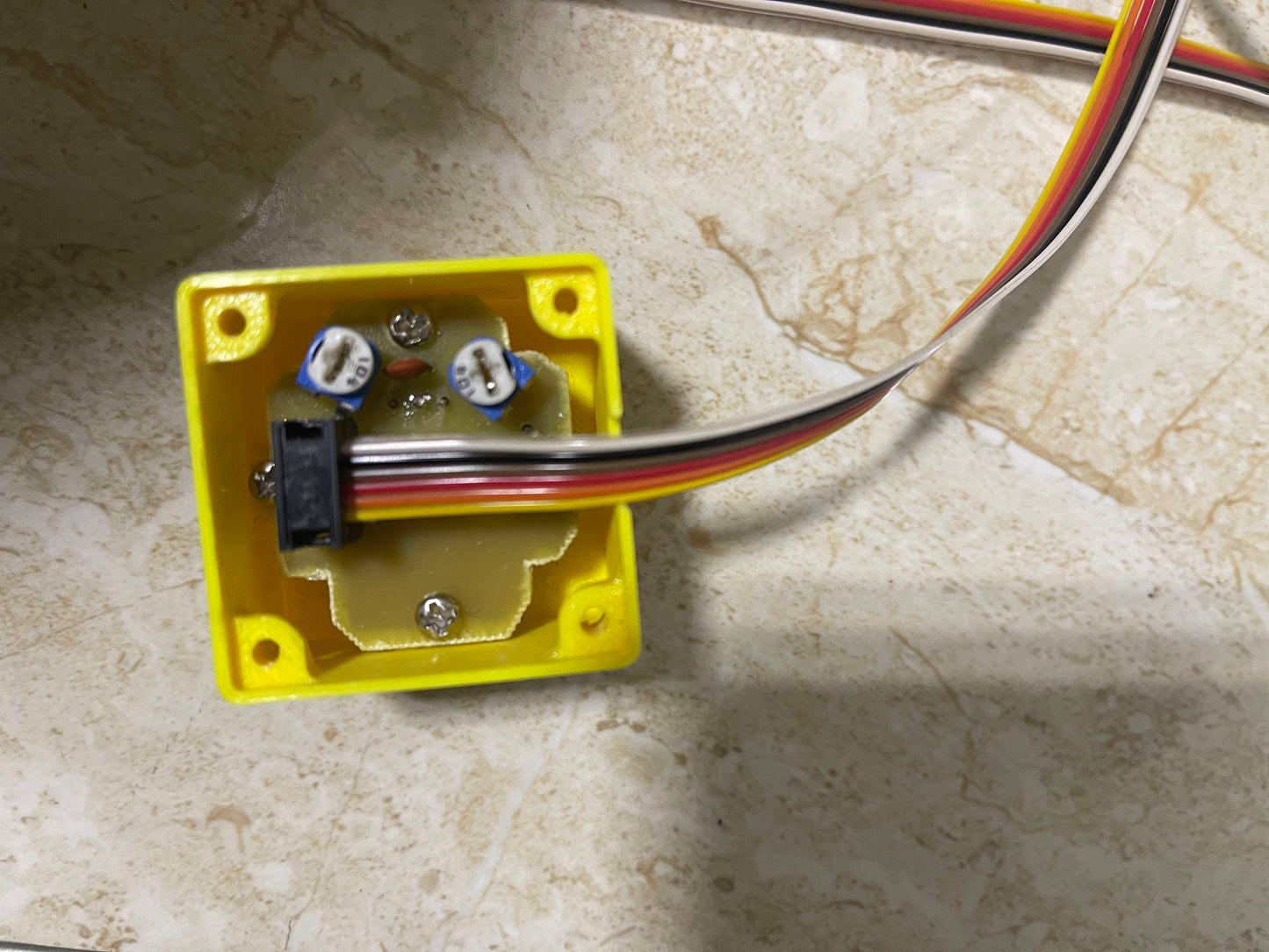
Rotary paddle controllers (analog potentiometer type)
Technical Specifications
Video Output: NTSC CVBS (Composite Video)
Audio Output: Analog audio
Power Input: 8V – 15V DC
Game Logic: 100% TTL discrete logic implementation
CPU: None (original hardware architecture)
How It Works
The original Pong is a pure hardware state machine.
There is:
No CPU
No firmware
No software rendering
Every aspect of gameplay is generated directly by hardware:
Ball X/Y position registers
Paddle input sampling
Collision detection and angle logic
Score counting
Sound generation
Horizontal & vertical scan timing
Composite sync signal generation
The video signal is generated directly in hardware and outputs analog composite video compatible with standard NTSC displays.
Paddle control uses analog potentiometers. The voltage is converted directly into paddle position via hardware comparison circuits.
This board preserves that original architecture.
About Pong (1972)
Pong (1972) was the first commercially successful arcade video game developed at Atari.
It was designed by engineer Allan Alcorn under the direction of company founder Nolan Bushnell.
Originally assigned as a “training project,” it became a global arcade sensation.
The prototype was tested at Andy Capp’s Tavern in Sunnyvale, California. The coin box famously filled beyond capacity within days — proving the commercial viability of video arcade games.
Technically, Pong was revolutionary because:
It used TTL logic instead of software
It generated composite video directly from hardware timing circuits
It implemented gameplay entirely through digital state machines
It required no processor
Pong directly launched:
The arcade video game industry
The home console market (Home Pong, 1975)
The widespread adoption of LSI chips in gaming hardware
Atari’s later platforms, including the Atari 2600
From a historical perspective, Pong represents one of the foundational origins of the modern video game industry.
Use Cases
Arcade restoration projects
Educational demonstration of discrete digital logic design
Retro hardware research
Museum or collector display systems
DIY arcade builds
Important Notes
This product is an independent hardware reproduction.
It is not affiliated with, endorsed by, or sponsored by Atari.
Requires external power supply (8–15V DC).
Requires composite display (NTSC).
Why This Board Matters
Modern recreations often use:
Microcontrollers
FPGA
Software emulation
This board does not.
It recreates the original logic structure using discrete TTL — preserving timing behavior, signal characteristics, and hardware interaction exactly as intended in the early 1970s.
For collectors, engineers, and historians, this is not just a game board.
It is a piece of digital logic history.
Original product page: https://www.tindie.com/products/johnson/pong-100-ttl-e-revision-mainboard-replica/